I had heard of micro-finance before, surprisingly enough in a humanities course I took many years ago. What surprised me most from this reading was the size and scope of the micro-finance industry across the globe. In the article the author claimed that over 140 Million people have been reached through these programs. While this is obviously not enough to eradicate poverty it is a great start.
There was nothing in the article that I found to be confusing. The article was well written and free of any over sue of technical jargon the average reader such as my self would find difficult to understand.
Two questions I have for the author would include: "How do you think more entrepreneurs and wealthy individuals can be encouraged to take part in such organizations?" and "Since crime is rampant in many of the worlds poorest places, how can you properly protect a lending infrastructure in this type of environment?"
There was nothing I disagree with in this article. It was written from the authors prospective and is based on his first hand experience in this industry. I cannot see how I have any right as an outsider to question anything he wrote.
Sunday, April 24, 2016

Final Reflection

This will be my 40th post on this blog. Had I completed every assignment it would be more but here I stand. As I look back through this blog I now have a better understanding of the logic and design of this course. It truly was a journey and one I will not soon forget. This has not been an easy semester for me, both inside and outside of class. I have had to deal with money, health, and car problems almost since the ball dropped last New Years. This class has been frustrating at times and that fact is almost better illustrated by the grade book than the blog. As I look through my weekly scores I can see where I had trouble and point out the moments where it all simply felt like too much. But now, here at the end, I can look back and be proud for making it here.
I can not pin down my most formative experience to a single assignment or blog post. I am can only judge it as an over all experience. The challenges of the deadlines and variety of assignments have forced me to grow as an entrepreneur and a person. The most enjoyable assignments for me were commenting on other blog posts and reading about other students ideas. I came across several over the course of this semester that really peaked my interest. I look forward to seeing if these idea are pursued into reality.
I do feel very strongly that I have grown as an entrepreneur as a result of this course and that I have a much deeper understanding of what makes up the proper entrepreneurial mindset. Besides the actual subject mater in the form of the readings and lectures I feel that the assignments played the largest roll in my growth as they required the application of what we learned in a real world (or hypothetical real world) scenario.
My advice to future students in this course would be the same as it was in my Half-Way Reflection. Time management is the key to success in this course just as it said in our first declaration. Take that assignment seriously and stick to a schedule for this class. Otherwise things will begin to pile up and assignments will be missed. Another key is to double check to make sure both the share and the declaration are completed. I did not receive points for assignments I completed because I forgot to declare. It is a system most of us are not used to.
Wednesday, April 20, 2016
Elevator Pitch No. 4
Venture Concept No. 2
A business without a sign is a sign of no business. Every business needs signage of one form or another. All existing businesses are potential customers.
Businesses need signage and the options to satisfy that need certainly aren't few in number. There are two other sign shops less than a quarter mile away from the shop I currently work at and at least six or seven in a five mile radius. Online options have sprung up in the past decade as well to help meet these needs. The problem arises out the duality in this industry: Want it cheap? Get it online. Want it done right? Get it from a local shop. Now of course this doesn't always hold true as there are plenty of brick and mortar shops that cut corners, but in the majority of cases this is what can be expected.
Most web-based sign offerings I have seen so far have been produced using cheap substrates and the print is hard to read and overall ineffective at it's intended use. Most of these companies allow little flexibility in the layout of the sign; they provide a set of templates with a choice of a few fonts and colors, then allow you to upload a small .jpeg and off you go. Going to a local sign shop is of course a viable alternative and in most cases a step up on the quality ladder, however most business persons tend to be very busy running their respective businesses. Few have time to take out of the working day to go to a shop and sit with someone and hash out the details for their signage. In my experience signage is a low ranking concern for most business people, usually not thought of at all until it is needed.
In summary, this is my customer:
- Business person of almost any type in any industry. Near universal demand for signage
- Understands that quality is more important than price when it comes to promoting their business, yet still value conscious.
- Has little time to deal with this unmet need, requires a user friendly system to place orders and make revisions
To meet the above needs my business is formed around the simple idea that with today's technological and logistic infrastructure, a quality sign can be produced and sold at a fair price to a customer any where in the country. Our website will be our storefront and will be designed around ease of used and especially ease of communication with the designer. It will feature a locally hosted file server to allow both the client to provide artwork files without any size limitation and to view high quality layouts without the worry of errors in transmission over fax or email. Once the customer has approved their layout with an electronic signature the production process will begin immediately.
Having real, bonafide, authentic, flesh and blood human designers is a large part of what sets us apart from other online signage offerings. The problem with many of the signs produced by these companies is that their layouts are generated by an automated program. The customer types in their verbiage and selects from a very limited font selection, and boom; the computer spits out a layout and what you get is what you get. What sets apart a quality sign from a scrap of material with letters on it is the details. Just because a sign says what you want it to say does not mean that it is communicating that message to the customer. In order for a sign to properly connect with the human eye and the human mind's eye, it must be designed by a human, and a competent one at that.

Venture Concept
By matching a simple and easy to use web interface with a production process focused on efficiency with out sacrificing quality we will be able to meet the needs of our customer. Our customers will come to us for their signage solutions because we provide the middle way, quality and convenience. Our competition is numerous, and fall into the two categories named above: Web based discount signage and local store fronts. The web based discount signage provider's primary weakness is their quality. You get what you pay for and most business owners I have met are wiling to pay for more than what they receive from these vendors. For the local store front the weakness is fundamental to their nature: they are immobile and inflexible, and often inconvenient.
Distribution and customer service are our primary concerns and vital to our success. Shipping costs for signage can be quite high simply because they are so oddly shaped. A normal package is relatively uniform, a sign on the other hand is usually two dimensional and can be quite large. To offset this we must negotiate reasonable rates with a preferred vendor to enable us to ship at a reasonable cost to the customer, otherwise our main selling point of convenience is overshadowed.
To make this business work most efficiently we would need at minimum three designers, and six production workers. This staff would be divided into three 8-hour shifts; a designer too handle both their own work as well as make any needed changes to the artwork during production, and two production workers to run the machines and assemble the product. With three shifts we will be able to run production around the clock which will enable the product to be finished and shipped as efficiently as possible.With appropriate investment in equipment such as flatbed printers, routers, plotters, and laminators we would be able to produce a wide variety of signage. The lack of overhead from a storefront we will be able to keep our prices down without needing to skimp on material.
Secret Sauce and the Future
My secret sauce is my understanding of this industry while also not having come into it by normal means. I had no interest in signage or graphic design before I took my current job. I took it because I was out of work. Being always somewhat of an outsider has allowed me to see things from a different perspective.
I would like to expand my venture into monumental signage. These sort of large and complicated projects have always interested me in my current job but I rarely have the opportunity to participate. I could incorporate this type of work into my current production process with an additional investment in equipment. I can wholesale the finished components to a local sign shop for final assembly and installation, allowing a healthy profit for the both of us.
Should my business be blessed with success I would hope to use it as a springboard to pursue my longtime goals of operating my own flight school. In five years I hope to have established the business to a degree that it becomes a go-to for signage and I am able to grow and expand. In ten years I hope to be able to leave the day to day operations to an experienced manager while I am able to pursue other projects.
Feedback
The feedback I received from my previous venture concept was largely positive and supportive. One point of criticism however did stand out and that was regarding what differentiated me from my competition. Upon re-reading my post I found myself to be in full agreement with the persons comment. To rectify the situation I added a paragraph to the Innovation section which I felt was to short anyway even on my first post. In it I described how utilizing human designers as opposed to automated programs sets my firm apart from other online sign companies. Its the subtle things in a sign's layout that sets it apart and I will be able to provide these vital subtleties to my customer in a way they are not currently able to receive. Other than that addition my post is largely unchanged based on the very positive feedback. I am confident that should the need arise, I could take this concept to an investor and know that it describes my vision well.
Sunday, April 17, 2016
Week 14 Reading Reflection
What stood out to me the most in this chapter was the need for corporate entrepreneurship in today's global economy. I know all to well how easy it is for a company to become set in it's ways and largely ignore new ideas or anything really that goes against the grain. It is an issue I face at work on an almost daily basis. For a company to survive and stay competitive it must undergo an almost constant and never ending cycle of change.
What I found most confusing was the corporate entrepreneurship strategy process. Initially I was unable to see how such a system would function but after reviewing it and comparing with my own experiences with change and growth in a business I now have a better understanding.
Two questions I have for the author would include: "At what point in the growth and life of a business would you say it becomes necessary to undergo corporate entrepreneurship and ensure that enough changes are made to adapt?" and "Would radical innovation be preferred over incremental in a situation where the existing product still meets customers needs but competition is beginning to take market share?"
There was nothing in these chapters that I found to be wrong. The author has presented this information in an understandable and informative manner.
What I found most confusing was the corporate entrepreneurship strategy process. Initially I was unable to see how such a system would function but after reviewing it and comparing with my own experiences with change and growth in a business I now have a better understanding.
Two questions I have for the author would include: "At what point in the growth and life of a business would you say it becomes necessary to undergo corporate entrepreneurship and ensure that enough changes are made to adapt?" and "Would radical innovation be preferred over incremental in a situation where the existing product still meets customers needs but competition is beginning to take market share?"
There was nothing in these chapters that I found to be wrong. The author has presented this information in an understandable and informative manner.
Going for Google Gold
I will be the first to admit that I did little, if any thing towards search engine optimization and promoting my blog. In truth my main concern was to simply complete the assignment itself and all of my effort went into the quality of the post, not its promotion. The most promotion I did was to provide a link to my own post for the assignment I was commenting on.
My keywords were the week number and the title of the post taken usually verbatim from the assignment. I selected these keywords based off of the instructions in the assignment, as I have said before I have done little else outside of what I was instructed to do in regards to promotion.
I do not use social media in any for personally, so therefore I didn't use social media to promote my blog. Should I pursue my business idea into reality I would certainly use social media to my advantage. While I have a personal distaste for it, I have seen its value both in this class and other marketing, business, and technology courses I have taken.
My most viral post was: "Elevator Pitch No. 2". I do not know why this is exactly. The feedback I received for this post was overwhelmingly positive so perhaps it was spread that way. It had 18 views and four comments.
Searching for both "Luke Logsdon blog" and "Luke Logsdon Week 13" (An arbitrary week number), one or more of my posts came up as the first result. To my surprise there are in fact other out there who share my name but my link still came up in the first spot.
My keywords were the week number and the title of the post taken usually verbatim from the assignment. I selected these keywords based off of the instructions in the assignment, as I have said before I have done little else outside of what I was instructed to do in regards to promotion.
I do not use social media in any for personally, so therefore I didn't use social media to promote my blog. Should I pursue my business idea into reality I would certainly use social media to my advantage. While I have a personal distaste for it, I have seen its value both in this class and other marketing, business, and technology courses I have taken.
My most viral post was: "Elevator Pitch No. 2". I do not know why this is exactly. The feedback I received for this post was overwhelmingly positive so perhaps it was spread that way. It had 18 views and four comments.
Searching for both "Luke Logsdon blog" and "Luke Logsdon Week 13" (An arbitrary week number), one or more of my posts came up as the first result. To my surprise there are in fact other out there who share my name but my link still came up in the first spot.
Wednesday, April 13, 2016
Very Short Interview Part 2
My first interview revealed a good deal about both my boss and what it takes to be an entrepreneur. I feel like that first interview has helped me in this course as it gave me insight into the entrepreneurial process from someone who has been doing it for thirty years.
For this interview I again sat down with my boss after work. My experiences, and indeed my frustrations in this class helped to influence my questions for this round. First I asked her if she could go back and do it all over again would she. Her response to this was yes. She said that being independent and being able to run her business how she pleases makes up for all of the troubles it has caused. She did say there were of course some details that she would change given the knowledge she has now, but over all she wouldn't choose a different path. I spent a few minutes explaining my business concept as it stands now after a semester of work. I had talked about some details of my idea before to her, indeed before I even took this class, but i had never "put it all together" for her before. I asked what she thought, and she believed the ideas have merit, but were not compatible with her current business model especially given the corporate rules which govern her as a franchisee. My final question was hypothetical given it would require me to quit working for her. I asked if I were to actually pursue my business venture, what my next step should be. She answered with: "Start making connections." This of course made me recall the social networking assignment. She went on to say that her customer database was the most valuable thing her business possessed. Equipment and workers can be replaced, but without that there is no business.
While we of course are not on equal footing in the subject of entrepreneurship, I feel my experiences in this course over the last semester have helped me to understand the world of an entrepreneur a bit better and allowed me to relate to my boss on more even ground, if even by a tiny amount. I could not accurately gauge how well I was coming across to her nor did I directly ask the question, however I feel that I have progressed on my journey, and I would imagine that she would agree.
For this interview I again sat down with my boss after work. My experiences, and indeed my frustrations in this class helped to influence my questions for this round. First I asked her if she could go back and do it all over again would she. Her response to this was yes. She said that being independent and being able to run her business how she pleases makes up for all of the troubles it has caused. She did say there were of course some details that she would change given the knowledge she has now, but over all she wouldn't choose a different path. I spent a few minutes explaining my business concept as it stands now after a semester of work. I had talked about some details of my idea before to her, indeed before I even took this class, but i had never "put it all together" for her before. I asked what she thought, and she believed the ideas have merit, but were not compatible with her current business model especially given the corporate rules which govern her as a franchisee. My final question was hypothetical given it would require me to quit working for her. I asked if I were to actually pursue my business venture, what my next step should be. She answered with: "Start making connections." This of course made me recall the social networking assignment. She went on to say that her customer database was the most valuable thing her business possessed. Equipment and workers can be replaced, but without that there is no business.
While we of course are not on equal footing in the subject of entrepreneurship, I feel my experiences in this course over the last semester have helped me to understand the world of an entrepreneur a bit better and allowed me to relate to my boss on more even ground, if even by a tiny amount. I could not accurately gauge how well I was coming across to her nor did I directly ask the question, however I feel that I have progressed on my journey, and I would imagine that she would agree.
Sunday, April 10, 2016
Week 13 Reading Reflection
What I found most surprising in the reading was the vast scope of factors that determine a venture's value. When I was in my teens my mother had toyed with the notion of selling her business. This was before the '08 crash and the business was doing quite well. I remember her coming up with a valuation that was over inflated and as a result couldn't find a buyer. I know she did not take all of the necessary steps to come up with a truly accurate valuation.
There was nothing in this chapter that I found to be confusing. Valuation is a complicated process but the author did a good job of breaking down the necessary steps.
Two questions I have for the author would include: "When doing a due diligence evaluation, what is a reasonable margin of error to keep in mind between the owners asking price and one's own valuation?" and "When basing value on assets and liabilities, how much value would you put on the experience of the workers themselves?"
There was nothing in this chapter I disagreed with. The author did a great job of breaking down valuation techniques and I feel I now have a better understanding of determining my businesses value.
There was nothing in this chapter that I found to be confusing. Valuation is a complicated process but the author did a good job of breaking down the necessary steps.
Two questions I have for the author would include: "When doing a due diligence evaluation, what is a reasonable margin of error to keep in mind between the owners asking price and one's own valuation?" and "When basing value on assets and liabilities, how much value would you put on the experience of the workers themselves?"
There was nothing in this chapter I disagreed with. The author did a great job of breaking down valuation techniques and I feel I now have a better understanding of determining my businesses value.
Celebrating Failure

A time I failed this semester was when my girlfriend and I came to the realization that our plans to move out of state this summer were not to be. I had received a job offer from an old boss now living in Tennessee. This offer and its location seemed to provide exactly what we were looking for so we perused a plan to be moved up there by this summer. I had already made arrangements with my current job to let them know of my plans and we had both told our families, who all live in this area. However about a month ago we reached a point where a decision to stay or go had to be made and we had to accept the fact that we weren't going to be able to leave due to a number of factors, money being the most paramount.
I learned a great deal from this experience. When the offer was first made to me, neither my girlfriend nor I could find any real flaw in our plan. In hindsight we both had a major confirmation bias. The facts that forced us to reconsider our plan were present from the beginning, but we refused to see them. This incident taught me to be much more objective in my decision making and goal setting. I have to force my self to weigh all of the facts, not just the ones that support my argument.
Failure is certainly embarrassing. When I had to tell my boss and my family that I wasn't going I felt almost ashamed of myself. As I stated above I was forced to re-evaluate the way I make decisions and set goals. I try to handle failure by moving past it and focusing on bettering myself. I do not like to dwell, although sometimes it really can't be helped. I think the challenges this class has presented and my own reflections in the assignments has helped my handling of risk to some measurable degree. Next time I plan a major life change I will be able to follow through.
Sunday, April 3, 2016
My Exit Strategy
In five years time I hope to have grown my business into a profitable venture and one in which I can pursue one of two options:

I do not think my exit strategy has effected my choices so far in any noticeable way. The amount of work required to make my vision into a reality is the same regardless if I plan to sell in five years or run it until I retire. The opportunity I identified came to me from my current job. My equipment would have to come the way of financing and hopefully the outstanding debts that would create would be paid off in five years time.
- Sell the business, invest the profits and pursue other life long goals
- Continue to own the business and focus on hiring and training a managerial staff so I can pursue other interests.

I do not think my exit strategy has effected my choices so far in any noticeable way. The amount of work required to make my vision into a reality is the same regardless if I plan to sell in five years or run it until I retire. The opportunity I identified came to me from my current job. My equipment would have to come the way of financing and hopefully the outstanding debts that would create would be paid off in five years time.
Week 12 reading Reflection
What stood out to me the most in this chapter was the lack of planning on the part of many ventures out there. In the chapter it stated that 20% of ventures they studied who had no real level of strategic planning failed within the first two years. I found this figure to be surprising.
I found the section on multistage contingency approach to be a little confusing as I had a hard time differentiating it from previously mentioned approaches to strategic planning.
Two questions I would ask to the author would include: "What is the best way to avoid fatal strategies in the initial planning process with a new venture?" and "If time is limited is it worthwhile to bring in a manger more skilled in planning?"
I do not disagree with the author on any major points. Overall this chapter was well written and informative on the benifits and pitfalls of the planning process.
I found the section on multistage contingency approach to be a little confusing as I had a hard time differentiating it from previously mentioned approaches to strategic planning.
Two questions I would ask to the author would include: "What is the best way to avoid fatal strategies in the initial planning process with a new venture?" and "If time is limited is it worthwhile to bring in a manger more skilled in planning?"
I do not disagree with the author on any major points. Overall this chapter was well written and informative on the benifits and pitfalls of the planning process.
Tuesday, March 29, 2016
Venture Concept No.1
Opportunity
A business without a sign is a sign of no business. Every business needs signage of one form or another. All existing businesses are potential customers.
Businesses need signage and the options to satisfy that need certainly aren't few in number. There are two other sign shops less than a quarter mile away from the shop I currently work at and at least six or seven in a five mile radius. Online options have sprung up in the past decade as well to help meet these needs. The problem arises out the duality in this industry: Want it cheap? Get it online. Want it done right? Get it from a local shop. Now of course this doesn't always hold true as there are plenty of brick and mortar shops that cut corners, but in the majority of cases this is what can be expected.
Most web-based sign offerings I have seen so far have been produced using cheap substrates and the print is hard to read and overall ineffective at it's intended use. Most of these companies allow little flexibility in the layout of the sign; they provide a set of templates with a choice of a few fonts and colors, then allow you to upload a small .jpeg and off you go. Going to a local sign shop is of course a viable alternative and in most cases a step up on the quality ladder, however most business persons tend to be very busy running their respective businesses. Few have time to take out of the working day to go to a shop and sit with someone and hash out the details for their signage. In my experience signage is a low ranking concern for most business people, usually not thought of at all until it is needed.
In summary, this is my customer:
To meet the above needs my business is formed around the simple idea that with today's technological and logistic infrastructure, a quality sign can be produced and sold at a fair price to a customer any where in the country. Our website will be our storefront and will be designed around ease of used and especially ease of communication with the designer. It will feature a locally hosted file server to allow both the client to provide artwork files without any size limitation and to view high quality layouts without the worry of errors in transmission over fax or email. Once the customer has approved their layout with an electronic signature the production process will begin immediately.
Venture Concept
By matching a simple and easy to use web interface with a production process focused on efficiency with out sacrificing quality we will be able to meet the needs of our customer. Our customers will come to us for their signage solutions because we provide the middle way, quality and convenience. Our competition is numerous, and fall into the two categories named above: Web based discount signage and local store fronts. The web based discount signage provider's primary weakness is their quality. You get what you pay for and most business owners I have met are wiling to pay for more than what they receive from these vendors. For the local store front the weakness is fundamental to their nature: they are immobile and inflexible, and often inconvenient.
Distribution and customer service are our primary concerns and vital to our success. Shipping costs for signage can be quite high simply because they are so oddly shaped. A normal package is relatively uniform, a sign on the other hand is usually two dimensional and can be quite large. To offset this we must negotiate reasonable rates with a preferred vendor to enable us to ship at a reasonable cost to the customer, otherwise our main selling point of convenience is overshadowed.
To make this business work most efficiently we would need at minimum three designers, and six production workers. This staff would be divided into three 8-hour shifts; a designer too handle both their own work as well as make any needed changes to the artwork during production, and two production workers to run the machines and assemble the product. With three shifts we will be able to run production around the clock which will enable the product to be finished and shipped as efficiently as possible.With appropriate investment in equipment such as flatbed printers, routers, plotters, and laminators we would be able to produce a wide variety of signage. The lack of overhead from a storefront we will be able to keep our prices down without needing to skimp on material.
Secret Sauce and the Future
My secret sauce is my understanding of this industry while also not having come into it by normal means. I had no interest in signage or graphic design before I took my current job. I took it because I was out of work. Being always somewhat of an outsider has allowed me to see things from a different perspective.
I would like to expand my venture into monumental signage. These sort of large and complicated projects have always interested me in my current job but I rarely have the opportunity to participate. I could incorporate this type of work into my current production process with an additional investment in equipment. I can wholesale the finished components to a local sign shop for final assembly and installation, allowing a healthy profit for the both of us.
Should my business be blessed with success I would hope to use it as a springboard to pursue my longtime goals of operating my own flight school. In five years I hope to have established the business to a degree that it becomes a go-to for signage and I am able to grow and expand. In ten years I hope to be able to leave the day to day operations to an experienced manager while I am able to pursue other projects.
A business without a sign is a sign of no business. Every business needs signage of one form or another. All existing businesses are potential customers.
Businesses need signage and the options to satisfy that need certainly aren't few in number. There are two other sign shops less than a quarter mile away from the shop I currently work at and at least six or seven in a five mile radius. Online options have sprung up in the past decade as well to help meet these needs. The problem arises out the duality in this industry: Want it cheap? Get it online. Want it done right? Get it from a local shop. Now of course this doesn't always hold true as there are plenty of brick and mortar shops that cut corners, but in the majority of cases this is what can be expected.
Most web-based sign offerings I have seen so far have been produced using cheap substrates and the print is hard to read and overall ineffective at it's intended use. Most of these companies allow little flexibility in the layout of the sign; they provide a set of templates with a choice of a few fonts and colors, then allow you to upload a small .jpeg and off you go. Going to a local sign shop is of course a viable alternative and in most cases a step up on the quality ladder, however most business persons tend to be very busy running their respective businesses. Few have time to take out of the working day to go to a shop and sit with someone and hash out the details for their signage. In my experience signage is a low ranking concern for most business people, usually not thought of at all until it is needed.
In summary, this is my customer:
- Business person of almost any type in any industry. Near universal demand for signage
- Understands that quality is more important than price when it comes to promoting their business, yet still value conscious.
- Has little time to deal with this unmet need, requires a user friendly system to place orders and make revisions
To meet the above needs my business is formed around the simple idea that with today's technological and logistic infrastructure, a quality sign can be produced and sold at a fair price to a customer any where in the country. Our website will be our storefront and will be designed around ease of used and especially ease of communication with the designer. It will feature a locally hosted file server to allow both the client to provide artwork files without any size limitation and to view high quality layouts without the worry of errors in transmission over fax or email. Once the customer has approved their layout with an electronic signature the production process will begin immediately.
Venture Concept
By matching a simple and easy to use web interface with a production process focused on efficiency with out sacrificing quality we will be able to meet the needs of our customer. Our customers will come to us for their signage solutions because we provide the middle way, quality and convenience. Our competition is numerous, and fall into the two categories named above: Web based discount signage and local store fronts. The web based discount signage provider's primary weakness is their quality. You get what you pay for and most business owners I have met are wiling to pay for more than what they receive from these vendors. For the local store front the weakness is fundamental to their nature: they are immobile and inflexible, and often inconvenient.
Distribution and customer service are our primary concerns and vital to our success. Shipping costs for signage can be quite high simply because they are so oddly shaped. A normal package is relatively uniform, a sign on the other hand is usually two dimensional and can be quite large. To offset this we must negotiate reasonable rates with a preferred vendor to enable us to ship at a reasonable cost to the customer, otherwise our main selling point of convenience is overshadowed.
To make this business work most efficiently we would need at minimum three designers, and six production workers. This staff would be divided into three 8-hour shifts; a designer too handle both their own work as well as make any needed changes to the artwork during production, and two production workers to run the machines and assemble the product. With three shifts we will be able to run production around the clock which will enable the product to be finished and shipped as efficiently as possible.With appropriate investment in equipment such as flatbed printers, routers, plotters, and laminators we would be able to produce a wide variety of signage. The lack of overhead from a storefront we will be able to keep our prices down without needing to skimp on material.
Secret Sauce and the Future
My secret sauce is my understanding of this industry while also not having come into it by normal means. I had no interest in signage or graphic design before I took my current job. I took it because I was out of work. Being always somewhat of an outsider has allowed me to see things from a different perspective.
I would like to expand my venture into monumental signage. These sort of large and complicated projects have always interested me in my current job but I rarely have the opportunity to participate. I could incorporate this type of work into my current production process with an additional investment in equipment. I can wholesale the finished components to a local sign shop for final assembly and installation, allowing a healthy profit for the both of us.
Should my business be blessed with success I would hope to use it as a springboard to pursue my longtime goals of operating my own flight school. In five years I hope to have established the business to a degree that it becomes a go-to for signage and I am able to grow and expand. In ten years I hope to be able to leave the day to day operations to an experienced manager while I am able to pursue other projects.
Sunday, March 27, 2016
Week 11 Reading Reflection
What I found most interesting in this weeks reading was the section about Corning. I was not aware that any companies still followed the centralized research lab set up that was so common a half century or more ago. It appears that success can still be had with this type of innovation strategy.
The section I found confusing was on Routine Innovation. And for the questions that I would have for the author would be at what point of change would an innovation be disruptive or radical instead of simply routine? Also due to the high cost of innovation in general, would it be a good trade off to try and tackle a radical innovation as the market leader?
There is nothing that i disagreed with in this article, it was well written and gave me further insight into the efforts companies must put into growth in improvement to stay alive.
The section I found confusing was on Routine Innovation. And for the questions that I would have for the author would be at what point of change would an innovation be disruptive or radical instead of simply routine? Also due to the high cost of innovation in general, would it be a good trade off to try and tackle a radical innovation as the market leader?
There is nothing that i disagreed with in this article, it was well written and gave me further insight into the efforts companies must put into growth in improvement to stay alive.
The Amazon Whisperer
The main revenue driver I have for my business is signage, as that is the product I am selling and the only way I can make money. This can be broken down among customer segments. As I see it I will be offering services on a B2C, B2B, and Wholesale level. This third revenue driver will be the focus on "Whats Next" for me.
This new service will allow me to enter a new segment of the sign market in the form of monumental signage. While my current experience as well as the current plans for my business primarily focus on the "Vinyl on a Rectangle" type of signage, I want to expand into the market for large, permanent signage. Entry into this market will allow sign shops around the country, similar to the one I currently work at, to sub-out the manufacture of these larger more complicated signs and ship the ready to install components to the company for an on-site install. This benefits both my self and my customer, regulations regarding sign installations vary from county to county and getting the required permitting is better left to the local shop doing the install. In exchange for not having to deal with this headache I am able to supply the components of a finished monument sign to the customer at a wholesale price, allowing both of us to make a good profit.
Amazon.com does not offer any sort of monument signage, nor would I expect them too. Instead I found a product relating to the services I intend to offer from the start:
http://www.amazon.com/Custom-Magnetic-Signs--Quality-Magnets/dp/B00ATH42DA/ref=sr_1_7?ie=UTF8&qid=1459096054&sr=8-7&keywords=magnetic+sign
This is a pair of 12"x24" vehicle magnetic offered for $39.99. The listing makes no mention of the thickness of the mag material nor of the process used to apply the copy (Cut vinyl, digital print, thermal print, etc.) so I cannot comment on the quality. This product has three reviews, all of them five stars. The listing for the product give a choice of sixteen colors and ten fonts. This is the primary thing I would change as I will not limit my customers in such a way. I have found that allowing a designer to use their creativity in addition to suggestions from the customer leads to the best signage. This product can be aligned to my business as it is very similar to what I will be offering but with the changes mentioned above.
This new service will allow me to enter a new segment of the sign market in the form of monumental signage. While my current experience as well as the current plans for my business primarily focus on the "Vinyl on a Rectangle" type of signage, I want to expand into the market for large, permanent signage. Entry into this market will allow sign shops around the country, similar to the one I currently work at, to sub-out the manufacture of these larger more complicated signs and ship the ready to install components to the company for an on-site install. This benefits both my self and my customer, regulations regarding sign installations vary from county to county and getting the required permitting is better left to the local shop doing the install. In exchange for not having to deal with this headache I am able to supply the components of a finished monument sign to the customer at a wholesale price, allowing both of us to make a good profit.
Amazon.com does not offer any sort of monument signage, nor would I expect them too. Instead I found a product relating to the services I intend to offer from the start:
http://www.amazon.com/Custom-Magnetic-Signs--Quality-Magnets/dp/B00ATH42DA/ref=sr_1_7?ie=UTF8&qid=1459096054&sr=8-7&keywords=magnetic+sign
This is a pair of 12"x24" vehicle magnetic offered for $39.99. The listing makes no mention of the thickness of the mag material nor of the process used to apply the copy (Cut vinyl, digital print, thermal print, etc.) so I cannot comment on the quality. This product has three reviews, all of them five stars. The listing for the product give a choice of sixteen colors and ten fonts. This is the primary thing I would change as I will not limit my customers in such a way. I have found that allowing a designer to use their creativity in addition to suggestions from the customer leads to the best signage. This product can be aligned to my business as it is very similar to what I will be offering but with the changes mentioned above.
Wednesday, March 23, 2016
My Venture's Unfair Advantage
3+ years experience in this field.
- Experience is the most valuable resource there is, in my opinion. It's value is high as it cannot be bought, only earned. It is not necessarily rare as there are plenty of sign shops and signage workers out there who have been around longer than I have. It can be imitated but only after three years. It cannot be substituted.
- Technical skills have value no matter what industry you are in. It is somewhat rare I would say due to it being a specialized skill set that has no calling outside of this industry. It is difficult to imitate as the day to day skills needed to operate and troubleshoot the machines can't be learned from the manual (Mostly because it is written in VERY poorly translated English.) It can be substituted if someone has experience running different yet similar equipment and can adapt.
- High value as it is something that will make or break a sign (not physically of course). It is rare as most people do not see the finer details that really tie a sign together. It is not difficult to imitate at my own skill level as I will freely admit I am not the greatest designer in the world.
- Understanding the customer's needs is very valuable especially when it leads to an up-sell. It is somewhat rare as it takes time and experience. It is difficult to imitate for the same reason as it is rare. There are no substitutions for this skill as without it you are relying entirely on the customers judgement, and when it comes to signage the customer is usually wrong simply due to ignorance.
- High value, having a relationship with all of the cogs that make the machine move is very beneficial, especially at start up. It is not rare as many people have good relationships with their suppliers. It can be imitated with enough time and money spent with a supplier. It can be substituted as all the suppliers I have networked with are more than happy to take on new business, but the sort of technical expertise I rely on them for would be hard to substitute with out the relationship we have.
- Its value is approximately $1000. This is only rare due to the fact that most people have more to their name. It can be easily imitated by working full time for low pay and having an apartment and utilities to pay for. It can be easily substituted for more money.
- I consider this resource to have a high value because it is one of the main factors that sets entrepreneurs apart from the rest. It is a rare resource as most people I know are more than happy to draw a wage for the rest of their lives. It cannot be imitated because you either have this drive or you do not. It cannot be substituted because if independence isn't your motivation it is unlikely you will be able to see the enormous challenge of entrepreneurship through since drawing a wage is a lot less stressful in most circumstances.
- I would say this is a valuable resource as it allowed me to grow up seeing the process of running a small business from the inside. It is rare because I don't know many other people with divorced parents who ran separate, independent businesses. This resource can't really be imitated as it's a situation you have to be born into. It can be substituted through other entrepreneurial experiences like internships, but even then it is doubtful to achieve the same level of immersion as a child growing up in this type of environment.
- Resourcefulness is very valuable, it has saved my bacon on many occasions. I don't think it is a rare trait although many people do not have it. It cannot be imitated as it requires thinking outside of the box, and some people are simply incapable of doing that. It can be substituted by always having the right tools and equipment for the job, but where is the fun in that?
- This is a valuable resource because my business is web based, and being able to do at least some of the work myself will save money. It is not a rare skill as most of my generation has at least some experience with computers. It can be imitated with a few courses in these subjects and some time spent practicing. It can be substituted by outsorcing the IT work to an appropriate firm, but that requires extra capital.
I would say the most important resource at my disposal is my experience. As I said before, experience cannot be bought, only earned. I suppose anyone could read up on the sign industry, buy themselves a printer and a plotter and go to town, but I doubt they will be successful. This industry, like any industry, requires experience to understand the ins and outs. You cannot afford to make rookie mistakes when you are running your own business.
Sunday, March 20, 2016
Week 10 Reading Reflection
I can comfortably that nothing surprised me in this chapter. I have taken both semesters of accounting as well as other managerial and entrepreneurship courses and all of the topics of this chapter have come up before.
Like the above I didn't find anything to be confusing in this week's chapter. All of this information about financial statements and so forth have been presented to me before. That being said I did have difficulty understanding the section on questionable costs but after rereading it I have a better understanding.
Two questions I would ask of the author would include: "In initial startup would it be abvisable to prepare statements yourself to save costs?" And "What is an acceptable ammount of time to plan for break even?"
There was nothing I disagreed with that the author started in this chapter as all of it was objective fact about the financial statements and processes .
Like the above I didn't find anything to be confusing in this week's chapter. All of this information about financial statements and so forth have been presented to me before. That being said I did have difficulty understanding the section on questionable costs but after rereading it I have a better understanding.
Two questions I would ask of the author would include: "In initial startup would it be abvisable to prepare statements yourself to save costs?" And "What is an acceptable ammount of time to plan for break even?"
There was nothing I disagreed with that the author started in this chapter as all of it was objective fact about the financial statements and processes .
Growing my social capital
For this exercise I contacted three people that I have had previously spoken to but only in a strictly professional context. What I mean by this is my communication with them in the past has been strictly to order supplies, schedule an install or some other type of day to day business operation. I have never used any of these three in an assignment before.
- The first person I made contact with is the owner and proprietor of a company that largely focuses on manufacturing and installing electric signage. I consider him to be my domain expert as he has been in business in this area for over 30 years. I contacted him via phone on my lunch break at work. Our conversation was brief as I didn't want to take up too much of his time. I explained the purpose of my call was to network for a school related business project. The favor he did for me was to open him self to advice should I need it. Having such an experienced person in my network I think will provide a great asset.
- The second person I contacted is someone who has run an engraving shop in my town for over 20 years. For the purpose of this assignment I would say she fills the role of market expert. The markets that we are both in aren't exactly the same but there is a lot of overlap, which is why I was able to make contact in the first place. I spoke with her when I went to pick up an order for engraved name plates that we had subbed out to them. Our conversation lasted a few minutes as I explained my project. I know she will be a valued asset in my network as from my conversation she knows a lot about our semi-shared market.
- The third individual I connected with is a valued supplier of ours. He is the manager of the local branch of a national signage supply company. Like my previous two contacts he has extensive experience in this industry as both a supplier and as a sign manufacturer himself. Of all three I would say he is perhaps the most valued contact in my network as his experience is very much focused in the same market as mine. I communicated with him via telephone on my lunch break and explained my project. He was interested in the online aspect of my business because the supplier he works for is trying to put much more focus on the web based aspect of their company as well.
I would say this was a valuable experience overall as it allowed me to form a closer relationship with people that I deal with on a somewhat regular basis. Understanding their own talents and experiences has allowed me to consider them to be more than just people I have to talk to do my current job, they are now people I can comfortably consider to be assets should I persue my business idea.
Tuesday, March 15, 2016
Elevator Pitch No. 3
Sunday, March 13, 2016
Week 9 Reading Reflection
What stood out to me the most in the reading was was the claim of the effectiveness of telemarketing. I worked as a telemarketer for a time when I couldn't find any other work, and it did not seem effective to me. I would also assume that telemarketing is on the decline due to many factors, especially due to ones pointed out by the author such as the DNC list and high turn over.
The only part I found confusing was the differences between a production-driven philosophy, a sales-driven philosophy, and a consumer driven philosophy. To me these are competing interests and must be balanced out rather than focusing solely on one.
Two questions I would ask the author would include: "What is the best way to balance out the three marketing philosophies?" and "Would, in your opinion, the negatives associated with telemarketing be worth the risk especially with internet marketing so well established?"
There is nothing I felt the author was wrong about in this section aside from my questions on the validity of telemarketing. This chapter was informative and helpful in an area which I am admittedly weak. Marketing is an area I need to improve on if I am going to make my business into a reality.
The only part I found confusing was the differences between a production-driven philosophy, a sales-driven philosophy, and a consumer driven philosophy. To me these are competing interests and must be balanced out rather than focusing solely on one.
Two questions I would ask the author would include: "What is the best way to balance out the three marketing philosophies?" and "Would, in your opinion, the negatives associated with telemarketing be worth the risk especially with internet marketing so well established?"
There is nothing I felt the author was wrong about in this section aside from my questions on the validity of telemarketing. This chapter was informative and helpful in an area which I am admittedly weak. Marketing is an area I need to improve on if I am going to make my business into a reality.
Tuesday, March 8, 2016
Idea Napkin No. 2
- I have worked in the signage industry now for over three years. While that time period isn't long, especially compared to my co-workers, it has netted me valuable experience in understanding what the customers needs are in this field. I am fortunate in that I have experience in every task in our little shop. I have experience in production, design, sales and installation. As far as my aspirations go, had the question been asked a year or so ago I would have been able to give a clear and detailed answer, now however I am not so sure. This business concept is one I have thought about since before taking this class, and should it become a reality I believe it would be the primary focus of my life.
- My company's purpose is to provide high quality signage to customers anywhere in the world. I have seen the current quality of online signage and I find it lacking. The unmet need of my customer is a reliable supplier of professional quality signage. In my time in this industry I have discovered that there is virtually no business that does not have a need for some form of signage. Even an entirely web based business still has a need for vehicle magnets and graphics to aid in promotion.
- My customer is a business person. I have determined both from my experiences at work and from my interviews that the average private citizen has little use for signage in their personal lives. The only call I have for signage for people not connected with a business entity is generally a birthday or anniversary banner, or perhaps a small vinyl decal for the back window of their car. Entrepreneurs and managers are the main purchasers of signage, and they are my target. Businessmen also understand the importance of quality and are willing to pay for a higher quality product if they believe the product will be a good investment. In the case of signage it is also a necessary investment.
- Customers will pay for my product because it will be of a higher quality than they can currently receive from an online sign company. While I may not beat the prices of places like Vista Print, I will beat their quality. In my current job I have many out of state customers whom I have never met face to face and likely never will. They communicate with us via email or phone and then we ship them their finished signage. My business will provide the same quality of product and service to the end user without the waste of a brick and mortar storefront. In addition, by providing an web based store front with an emphasis on user-friendliness, my company will be just as readily accessible and mass-marketable as my competitors.
- My core competency that sets me above my competition is a personal belief that if you deliver a quality product to the customer then they will come back. A sign isn't like most retail products. A sign is as unique as the person or company who has commissioned it. It is not mass produced (unless it's a bandit coroplast) and has to truly represent the identity of the company whose logo is on it.
The feedback I received was largely positive and didn't involve any suggestions for improvement. All of the commenters mentioned my focus on quality over price as a positive. I tried to further emphasize on this point in this post. Another benefit that was mentioned in the comments was that I am a business to business enterprise. I to believe this is a plus, and I expanded upon that point in item number three. Having taken the time to reread my last post and to reflect on the feedback I believe I have a better understanding of these five elements.
Sunday, February 28, 2016
Half-way Reflection
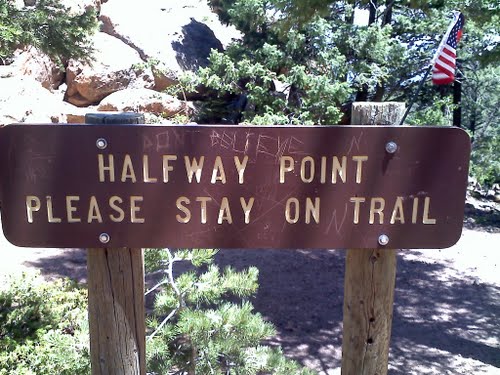
The behaviors I have used to help in overcoming the challenges of this course have concerned time management and over coming anxieties. The course schedule is not one I am used too. The majority of online classes I have taken have had all materials for the week due Sunday at midnight. This was a convenient schedule for me as I work full-time during the week. This classes schedule of course is spread through the week with assignments due at 9:00 p.m instead of midnight. This created problems for me early on as I often don't get home until between 6-7 and sometimes later. The other skill I have improved is overcoming the anxiety associated with being on camera and approaching strangers. I am normally a private person who does not use social media so this is out of my comfort zone.
One moment where I felt like giving up was during the customer interviews. I was only able to complete five but that itself felt like an accomplishment when it was over. Other times have come through the last two months just due to the work load and schedule but I believe I have adapted well and am optimistic about the rest of the semester.
Three tips that I would give to new students next semester would be: Stay focused; Don't procrastinate; and Plan ahead. Staying focused is vital in this course as even a day's inattentiveness can make you fall behind either with new posts or commenting on others. Procrastination is a problem that I know I face and many others do as well and over coming that is needed on this type of schedule. Finally planning ahead is need more in this course than others as an assignment requiring you to interview strangers can't be completed the night before or the day of. For these type of assignments I have needed to begin planning my schedule days in advance to get it done.
Week 8 Reading Reflection
The biggest surprise for me in the reading was to learn that angle investments make up a larger pool of funds for entrepreneurs, especially those in the process of starting up a firm. According to the text angel investments are five times greater than investments from venture capital firms.
The only part of the reading that I found confusing was the section referring to accredited purchasers. After re-reading the section I have a better understanding as to the requirements to be considered accredited and also the limitations that come without being accredited.
Questions I would ask the author would include what would be the best method in determining the right avenue of financing to take. The chapter outlined several options ranging from commercial banks to informal investors. It seems that the right choice in money source could make or break a business with debt or relinquish to much control in the form of equity.
There was nothing in the reading that I disagree with the author or believe they were wrong about. I learned a great deal in this chapter about financing a business that I did not know before.
The only part of the reading that I found confusing was the section referring to accredited purchasers. After re-reading the section I have a better understanding as to the requirements to be considered accredited and also the limitations that come without being accredited.
Questions I would ask the author would include what would be the best method in determining the right avenue of financing to take. The chapter outlined several options ranging from commercial banks to informal investors. It seems that the right choice in money source could make or break a business with debt or relinquish to much control in the form of equity.
There was nothing in the reading that I disagree with the author or believe they were wrong about. I learned a great deal in this chapter about financing a business that I did not know before.
Saturday, February 20, 2016
Week 7 Reading Reflection
What surprised me the most in this weeks reading was the over all ineffectiveness of traditional market segmentation. I have always heard of market segmentation being used in the sort of "cut and dry" way and always assumed that it was an effective tool. What really illustrated this too me was that only 14% of the senior executives surveyed believed they received benefit from the segmentation exercise.
What confused me the most is that segmentation is still in such wide use despite the fact that it has been proven to be largely ineffective. Surely in today's highly competitive market experienced executives would understand that the techniques for identifying customer groups most be updated to match the current market conditions
The questions I would ask to the author would involve the best methods of identifying profitable customer groups. The authors indicated that one must be selective in prioritizing market groups, but in that scenario who can you be sure that a segment isn't being overlooked that could potentially be more profitable. I know in my own experiences this can be a challenge.
I did not find anything in the reading that I would say the author was wrong about. I found this article to be very informative and admittedly has changed my perception on the methods needed to understand who your customer is and what their needs are.
What confused me the most is that segmentation is still in such wide use despite the fact that it has been proven to be largely ineffective. Surely in today's highly competitive market experienced executives would understand that the techniques for identifying customer groups most be updated to match the current market conditions
The questions I would ask to the author would involve the best methods of identifying profitable customer groups. The authors indicated that one must be selective in prioritizing market groups, but in that scenario who can you be sure that a segment isn't being overlooked that could potentially be more profitable. I know in my own experiences this can be a challenge.
I did not find anything in the reading that I would say the author was wrong about. I found this article to be very informative and admittedly has changed my perception on the methods needed to understand who your customer is and what their needs are.
Tuesday, February 16, 2016
Elevator Pitch No. 2
Sunday, February 14, 2016
Week 6 Reading Reflection
What I found was the most surprising about the reading were the advantages of incumbents. I had never thought of these advantages when thinking of the threats facing new ventures. Its easy to believe that by providing a superior product one can easily compete with existing competitors, but the connections made within a community can be an incumbent's best asset.
I didn't find any thing in the reading confusing, the article was well written and the concepts presented are easy to understand.
My questions to the author would include: "What would be the best method of reducing the threat of rivalries forming among competitors in an industry?" The author claims that rivalry is destructive to an industry. Another question would be: "How would you determine the ideal industry growth rate as an investor?"
I found nothing in the article that I disagree with. I have read of the five forces before in other classes I have taken and nothing here has contradicted what I know.
I didn't find any thing in the reading confusing, the article was well written and the concepts presented are easy to understand.
My questions to the author would include: "What would be the best method of reducing the threat of rivalries forming among competitors in an industry?" The author claims that rivalry is destructive to an industry. Another question would be: "How would you determine the ideal industry growth rate as an investor?"
I found nothing in the article that I disagree with. I have read of the five forces before in other classes I have taken and nothing here has contradicted what I know.
Tuesday, February 9, 2016
Idea Napkin No. 1
- I have worked in the signage industry now for over three years. While that time period isn't long, especially compared to my co-workers, it has netted me valuable experience in understanding what the customers needs are in this field. I am fortunate in that I have experience in every task in our little shop. I have experience in production, design, sales and installation. As far as my aspirations go, had the question been asked a year or so ago I would have been able to give a clear and detailed answer, now however I am not so sure. This business concept is one I have thought about since before taking this class, and should it become a reality I believe it would be the primary focus of my life.
- My company's purpose is to provide high quality signage to customers anywhere in the world. I have seen the current quality of online signage and I find it lacking.
- My customer is a business person. I have determined both from my experiences at work and from my interviews that the average private citizen has little use for signage in their personal lives. The only call I have for signage for people not connected with a business entity is generally a birthday or anniversary banner, or perhaps a small vinyl decal for the back window of their car. Entrepreneurs and managers are the main purchasers of signage, and they are my target.
- Customers will pay for my product because it will be of a higher quality than they can currently receive from an online sign company. While I may not beat the prices of places like Vista Print, I will beat their quality. In my current job I have many out of state customers whom I have never met face to face and likely never will. They communicate with us via email or phone and then we ship them their finished signage. My business will provide the same quality of product and service to the end user without the waste of a brick and mortar storefront. In addition, by providing an web based store front with an emphasis on user-friendliness, my company will be just as readily accessible and mass-marketable as my competitors.
- My core competency that sets me above my competition is a personal belief that if you deliver a quality product to the customer then they will come back. A sign isn't like most retail products. A sign is as unique as the person or company who has commissioned it. It is not mass produced (unless it's a bandit coroplast) and has to truly represent the identity of the company whose logo is on it.
Sunday, February 7, 2016
Interviewing Customers No. 2
As I was unable to complete the last assignment this is my first experience with interviewing customers. I came up with four simple questions to gauge my preconceptions about the opportunity. My questions were:
I learned that when interviewing strangers that I could have used less general questions. I assumed that I should keep it as simple as possible to avoid confusion. I explained the questions before filming, and perhaps I would have done better by making it more spontaneous. After these interviews I believe my opportunity of an online sign shop is still viable but will require a targeted market. My tips to next semester would be: 1. Be specific, 2. Keep an open mind about who your customers are, and 3. Don't be nervous.
- How much of your total shopping do you do online?
- Have you ever purchased signage before?
- What matters more to you, quality or price?
- Would you or have you payed more for faster shipping?
I learned that when interviewing strangers that I could have used less general questions. I assumed that I should keep it as simple as possible to avoid confusion. I explained the questions before filming, and perhaps I would have done better by making it more spontaneous. After these interviews I believe my opportunity of an online sign shop is still viable but will require a targeted market. My tips to next semester would be: 1. Be specific, 2. Keep an open mind about who your customers are, and 3. Don't be nervous.
Week 5 Reading Reflection
What stood out to me the most in this week's reading was the emphasis on understanding the causes of failure. As we all know well, the odds are against you when starting a business. I think what stood out the most was the failure prediction model and it's use of the role of debt. From what I have personally seen, some entrepreneurs don't give enough attention to the role that debt will play and how liabilities will stack up in lean times.
There was nothing in the reading I can say I truly found confusing, although the section referring to Z-scores seems foreign to me as I do know understand how they relate to finance. This is something I will have to do further research on.
My questions to the authors would include: What would the best way to appropriately test a product's technical feasibility on a large scale while constrained by a budget? Also, what is the best way to judge a competitive advantage when entering an existing market?
There was nothing in the chapter I disagreed with. I would say they were spot on the analysis of risks a new venture faces and reinforcing the need for truly objective analysis of the feasibility of the venture
There was nothing in the reading I can say I truly found confusing, although the section referring to Z-scores seems foreign to me as I do know understand how they relate to finance. This is something I will have to do further research on.
My questions to the authors would include: What would the best way to appropriately test a product's technical feasibility on a large scale while constrained by a budget? Also, what is the best way to judge a competitive advantage when entering an existing market?
There was nothing in the chapter I disagreed with. I would say they were spot on the analysis of risks a new venture faces and reinforcing the need for truly objective analysis of the feasibility of the venture
Wednesday, February 3, 2016
Elevator Pitch No. 1
I apologize for the quality, it's all I have to work with. My opportunity comes from the general lack of quality I have noticed from online signage retailers. My solution is to provide the same quality one would expect from their local sign shop any where in the world. I am kicking around the "Net Signs" but I didn't include it in the video because I don't know if I will keep it.
Sunday, January 31, 2016
Week 4 Reading Reflection
In this week's reading on creativity and innovation, what stood out to me most initially was my own identification to the steps of the creative process. The way the process progresses is the way it has always happened when ever I have had a new idea. I had never thought of it being a process that could be divided in clear steps, but now that I am able to reflect on my own experiences it fits well.
The only part of the reading I found confusing was the section on probability thinking. The author claims that dice can be used as an example that predictive power increases as the experiment is repeated, but the probability of rolling a "4" is the same rolling once or after rolling it 1,000 time. 1/6.
My questions to the author would include what they felt are the best techniques for bridging the gap from coming up with the desired solutions to implementing those solutions. This is, in my opinion, the most difficult step. Coming up with the next million dollar idea is commendable, but until that idea is developed into something concrete it is useless.
My only disagreement with the author would come with what I stated previously about probability thinking. It is possible however that I misinterpreted the analogy. Perhaps the only other point I might contend would be the claim that all people are creative in some degree, but I would not necessarily agree with that as I think what many people see as creativity is merely repetition with slight variances.
The only part of the reading I found confusing was the section on probability thinking. The author claims that dice can be used as an example that predictive power increases as the experiment is repeated, but the probability of rolling a "4" is the same rolling once or after rolling it 1,000 time. 1/6.
My questions to the author would include what they felt are the best techniques for bridging the gap from coming up with the desired solutions to implementing those solutions. This is, in my opinion, the most difficult step. Coming up with the next million dollar idea is commendable, but until that idea is developed into something concrete it is useless.
My only disagreement with the author would come with what I stated previously about probability thinking. It is possible however that I misinterpreted the analogy. Perhaps the only other point I might contend would be the claim that all people are creative in some degree, but I would not necessarily agree with that as I think what many people see as creativity is merely repetition with slight variances.
Wednesday, January 27, 2016
Top 5 World Problems
Top 5 Problems


- Water Scarcity
- Finite Energy Sources
- Terrorism
- Corruption
- Social Division
Top 5 Solutions
- Fuel Competition
- Harsher punishment for corruption
- Fair and proactive management of water resources
- International coalition against ISIS
- Fostering national unity and identity.

All of the problems I listed are severe, but I chose Water Scarcity as my number one due to the fact that we simply cant make more water. What the planet provides us is what we have. While we do have the ability to create more drinking water through desalinization and reclamation, this only works in certain areas and doesn't change the fact that there are to many people living in areas prone to drought. Without careful management of water supplies moving forward we may very well see some "Water Wars." The other problems I listed are urgent and important, but without sufficient water supplies civilization simply cannot exist.

As for my solutions, I picked fuel competition as the most implementable because it has been implemented in certain areas like Brazil with great success. I am a firm believer in the free market, and the oil industry's monopoly on the transportation industry stands in stark opposition to the concept of a free market. It would take a small comparative investment to modify the majority of the road traveling fleet, consumer or commercial, to accept multiple fuel sources or sources other than petroleum. In fact the municipal buses in my area now run off of CNG.
Sunday, January 24, 2016
Wek 3 Reading Reflection
What stood out for me the most in this week's reading was the sheer amount of traits found in entrepreneurs. It's typical to think of an entrepreneur as simply a "Go Getter" and nothing more but there is much more to them than that. There was nothing I found particularly confusing about this chapter. The entrepreneurial mindset has a duality and the author illustrated this well. The main question I would ask is where does one draw an objective line when notating the difference between an entrepreneur and a gambler? I found nothing wrong with the information presented in the chapter as most of it was objective. Motivation is a tricky thing to measure and categorize, and it manifests itself differently in all of us, so perhaps the only thing i would question is the ability to create an accurate flow chart of motivation.
Idnetifying Local Opportunities
- "Interstate Project Gets Bad Ranking."
This story highlights a report that was recently published that listed Tampa's never ending interstate expansion project as one of the 12 worst in the nation. The problem is well known to anyone who has ever driven into or out of Tampa. The highway system has become an entangled mess, half of which is under construction at any given time. The report also highlights FDOT's intention to demolish a historic church in Tampa Heights that is currently used as community center and garden. At this point I honestly believe they would do something like that. The problem here belongs to FDOT directly but its effects are felt by the community. There is a reason the I-4/ I-275 interchange is known as "Malfunction Junction."
2. "As Ranks Of Drivers Fall, Mass Transit Needs Surge".
http://infoweb.newsbank.com.lp.hscl.ufl.edu/resources/doc/nb/news/15A8445B9C882360?p=AWNB
Tampa has next to no public transportation. Buses make up nearly all of what little there is. This story connects Tampa's longstanding problem of lack of mass-transit (most of the money having been spent on bigger roads, a problem detailed above), with a new study showing that fewer people are learning to drive. This means that more people will rely on public transportation and therefore be forced to live in a city that can provide it. As above the problem belongs to the City of Tampa but its effects are felt by the people. More investment in public transit is needed in this area.
3. "Citizens Below 500K Policies."
http://infoweb.newsbank.com.lp.hscl.ufl.edu/resources/doc/nb/news/15A8445B9C882360?p=AWNB
This article illustrates a problem being solved in Florida and also an opportunity for businesses. Citizens Property Insurance Corp. commonly referred to as just "Citizens" now has fewer than 500,00 policies, which is a good thing. Citizens was formed as the state's insurer of last resort and quickly became the largest insurer in Florida after many private insurance firms bowed out due to the hurricanes we received. The problem created then was for the homeowners, Citizens' rates were enormous, as I learned first hand when I worked for a marketing firm for contractors. Now that Citizens' membership is decreasing, it shows the private insurance market is returning, which results in much lower rates for homeowners.
4. "Tampa Seeks Park Funding."
http://infoweb.newsbank.com.lp.hscl.ufl.edu/resources/doc/nb/news/15A2A900EEA3BA50?p=AWNB
The Julian B. Lane Riverfront Park in Tampa is now projected to cost over $30 million. The city faces the problem of budgetary restraints in order to finish the project and is now asking the state for help. The main problem is in the use of money set aside by Amendment 1 in 2014 is disputed. Some say it was against the intent of the voters for so much money to be put in a park. The problem belongs to the legislators who as usual, are unable to compromise.
5. "Innovation Is Problem For Florida".
http://infoweb.newsbank.com.lp.hscl.ufl.edu/resources/doc/nb/news/15A2A900EEA3BA50?p=AWNB
In a recent report, Florida was listed as 35th in a ranking of the most "Innovative" states. While we scored well in a few categories such as tech density and number of patents, we we held back by very low scores in STEM concentration, R&D density, and number of STEM degree holders. This is a problem for business and education in Florida. For our economy to keep pace we need to have high tech industry and and educated populace to man it's ranks.
Friday, January 22, 2016
Very Short Interview No. 1
The entrepreneur I interviewed is my boss, Chris Britt. She and her husband Gary purchased a Signs Now franchise 30 years ago and it is still in continuous operation to this day. Over the years they have owned three other Signs Now franchises in Tampa and Carrolwood but eventually sold those off, keeping their original. Chris manages the shop in person while Gary manages the finances.
First I asked her what set entrepreneurs apart, and after some consideration she said it was a determination to never give up even when times got tough. They were hit hard in '08 but managed to stay afloat, again through sheer determination. Next I asked what I should hope to learn to be a better entrepreneur and her response was time management. It is easy to get caught up focusing on a single task for so long that you miss your other responsibilities. Finally I asked her what she disliked the most about entrepreneurship and owning her own business and she came back quickly with "The long hours." I expected that response as Chris works late almost everyday, sometimes stretching into the wee hours of the morning. As an hourly employee I have the privilege of leaving at 5:30 regardless of the workload. She of course does not share this privilege and knows it is on her to ensure all of our work is done by the customer's deadline, even if that means picking up the slack herself.
I found this interview to be informative. Ever since I was first hired I have passively observed how she ran things. I have considered it to be a case study in how to run a successful business. This interview allowed me to make a more active observation and provided valuable insight into the mind of an entrepreneur.
First I asked her what set entrepreneurs apart, and after some consideration she said it was a determination to never give up even when times got tough. They were hit hard in '08 but managed to stay afloat, again through sheer determination. Next I asked what I should hope to learn to be a better entrepreneur and her response was time management. It is easy to get caught up focusing on a single task for so long that you miss your other responsibilities. Finally I asked her what she disliked the most about entrepreneurship and owning her own business and she came back quickly with "The long hours." I expected that response as Chris works late almost everyday, sometimes stretching into the wee hours of the morning. As an hourly employee I have the privilege of leaving at 5:30 regardless of the workload. She of course does not share this privilege and knows it is on her to ensure all of our work is done by the customer's deadline, even if that means picking up the slack herself.
I found this interview to be informative. Ever since I was first hired I have passively observed how she ran things. I have considered it to be a case study in how to run a successful business. This interview allowed me to make a more active observation and provided valuable insight into the mind of an entrepreneur.
Tuesday, January 19, 2016
Worlds Biggest Problems

- Water Scarcity. Some have predicted we may very well see "Water Wars" in our lifetimes. This isn't a problem unique to the poorer areas of the planet. Over the summer we saw these problems take shape here in our own country in California. This is a complex problem with many causes, overpopulation being front and center. My suggestion would be for municipal governments in at-risk areas to take a more active role in managing water supplies, and ensuring agricultural consumers are not abusing the public supply.
- Finite Energy Sources. While we are currently enjoying gas prices we haven't seen in a decade, it will not last forever. Eventually the wells will dry up, and when that day comes we had better have a proper infrastructure built to supply our energy needs. My suggestion would be to open up the fuel market to ethanol, methanol, and CNG in the near term, and expand investment in electric and hydrogen propulsion for the future.
- Poverty. Poverty is a problem that has plagued man since the dawn of civilization. It has to many causes to list and has led to war and revolution around the globe. My only suggestion would be for international organizations to focus on ensuring people have access to education and a free market.
- Apathetic, distracted populations. Democracy fails when people stop paying attention and become complacent. This allows individuals who do not have the interests of their people at heart rise to power. Returning civics education to our schools would be a start, but the best answer would be to foster an environment where citizenship is prized not just for its handouts but also its responsibilities.
- ISIS/ International Terrorism. Terrorism represents a threat to civilization, both west and east. As the late Jeff Cooper said "The only answer to violence is more violence, applied by the right people in the right way. A true international coallition must be formed to meet this threat. Not one based on alliances from the Cold War, but one that brings together the West and the East together in common cause.
- Corruption. Governments are supposed to be the voice of and advocate for the people. To fight corruption the laws must change to view the betrayal of the public trust in this manner as the heinous crime that it is. One corrupt individual undermines the entire system of government, especially when the perpetrator is given nothing more than a slap on the wrist.
- Waste. No society can ever achieve 100% efficiency, but we can certainly try harder than we are now. When living on a planet with finite resources we should take better care of what we have. We are now seeing the effects of previous generations' mishandling of resources, and if we want to have anything to pass on to our decendants than we must understand that that will entail sacrifice.
- Social division. Society seems more divided now than ever before. If we do not learn to put aside our differences soon it is highly likely we wont have a society any more. Difference of opinion will never go away, but what is most important is that we restore a sense of national identity. Once we can all agree that we are at least on the same team perhaps then we can more forward.
- Greed. Greed is seen in every class of society, from the top 1% to the bottom of the ladder. Some would argue that greed is a part of human nature, an extension of our survival instinct. The only solution, if you can call it that, is for society as whole to understand that fulfillment doesn't come from having the most stuff.
- Suicidal altruism. Our western liberal values and Christian traditions have taught us that we must provide help to those in need. These values certainly aren't wrong, but they must be measured against the cost. No society can withstand an unlimited constant influx of unassimilated foreigners. For us to help the world first we must ensure our own people are safe and secure.
Sunday, January 17, 2016
My Bug List
- People who leave shopping carts scattered in the parking lot. This has always bothered me as loose carts tend to block otherwise open parking spaces, and is just a sign of general laziness as a cart rack is usually no more than ten to twenty yards away. I can't say this is a totally unmet need as Aldi has come up with a good solution with their "Quarter Locks" as I like to call them. In order to get a shopping cart at Aldi one must put a quarter in the little receiver to unlock it from the rack. If you return it at the end you get your quarter back and from what I have seen this system works.
- People who do not use turn signals when turning or changing lanes. This is a safety hazard especially since the ones who never seem to signal are usually the ones distracted by their phones.
- Large brick power transformers. This is likely a common complaint. Most of or modern electronics run of of DC, which means in order to power our devices a transformer has to be used to convert line AC to DC. This often results in a large brick with the receptacle built in. These bricks can block multiple outlets on a power strip which limits its usefulness. The solution to this would be to include a small extension with the transformers similar to a laptop charger, although this of course would raise the cost of materials.
- People being generally rude. There simply is no excuse for it. Holding open a door for someone or returning a friendly greeting from a passer-by takes little to no effort. The world is a bad enough place as it is, being generally kind and respectful makes it a little more bearable.
- Stop lights without any sort of variable timing. Getting caught at a stop light late at night and sitting through a whole cycle with out a single car crossing your path is frustrating and wasteful. With cost of integrated electronics and the "Internet of Things" coming to fruition, it's high time our traffic control infrastructure was updated to keep pace. I would estimate that the cost to the public treasury would be offset by the overall savings to society.
- Click-bait trash. The internet was supposed to bring the combined knowledge of mankind to the masses. All it seems to bring anymore are selfies and click-bait trash. Finding legitimate, unbiased information seems harder now than ever before. "Journalists" no longer make their money by investigating and seeking the truth, they make it by throwing together fifteen screen shots of twitter that "Perfectly describe being a 90's kid", supported by ad's that are probably loaded up with Java exploits.
- Netflix asking if you are still watching. I understand this is a useful feature if you fall asleep, but Netflix has changed how we consume media. They should take that into account they next time they force you to move for the first time in three hours.
- People who bring their vehicles to get lettered without washing them first. This complaint is unique to my line of work, but if you want me to put a bunch of vinyl logos and lettering on your vehicle, wash it first. Otherwise you may not be happy with the result.
- Not having the ability to adjust alignment on cuts. Another specific of sign shops. When producing a large number of small decals, they are printed in one large sheet and run through a plotter to cut them to the desired shape. The problem is that sometimes the weight of the material causes the alignment to shift as it is run back and forth along the x-axis. There is no way to stop and change the alignment once it goes off and the result can be half or more of a run can be wasted.
- Chronic Procrastinators. Can be frustrating to anyone in any made to order industry. Being a small shop with relatively old equipment, we rely on our skills and customer service to stay competitive. This means if your deadline is tomorrow and you forgot about it until today, we will do our best, but the quality may suffer. Take your time and do it right.
- The line at the Chick-Fil-A on Causeway and Providence. About the only fast food i can eat without feeling greasy and ill, but the line is always stretching around the building at almost any hour of the day.
- Lack of public water fountains. Florida summers can be brutal, and with obesity at all time highs people could use some encouragement to leave their A/C'd comfort for a while to get some exercise. A refreshing water fountain can really help to offset the effects of our "Surface of the sun" ambient temperature.
- Ineffective and wasteful government. Has plagued man since the dawn of civilization and still no one has found the answer.
- Home owner's associations. While they personally don't effect me I have many clients that they do. To me the thought of paying someone to tell you what you can and can't do on your own property seems ludicrous. Those same people reserve the right to confiscate your own property for failing to pay their ransom. I suppose the comparison could be made to property tax, but at least property tax provides funding to local schools. The only thing HOA fees fund are gates, and guys like me to make more signs telling you what you can't do. I don't claim that their should be no organization on the neighborhood level, but many HOA's act like petty tyrants.
- Everyone has Fibre but me. Every other building in my complex has FIOS except mine. As a result i have VDSL, and am paying more for slower speeds than I was when I had FIOS.
- The 9 A.M. Lotto player. Usually retired, disabled, or simply out of work; They're in their pajamas going for the true variety pack of lotto tickets, and are keeping you from buying your coffee and getting to work on time. There is no solution to this problem that I can see other than adding another cashier.
- Poor service at retail stores. Not to say all retail workers don't care, but there are those who simply can't be bothered to help you. This problem has many causes beyond the individual. Working a menial job for little pay is hard, I know, but we all have to get through it. I have found that taking pride in your work can be difficult in circumstances like these, but it is necessary to get through it with some level of dignity intact.
- Celebrity gossip. As previously mentioned journalism is in a bad way. The situation is made worse when stories about celebrity gossip constantly overshadow coverage of major world events. When more people are concerned with what happens with the Kardashians than with Syria there is a serious problem.
- Double Parking. If you can't fit your Honda Civic in a single parking space in a crowded parking lot I don't think you need a license.
- Chronic Complainers. While ironic on a list of complaints, there are few things worse than a person that simply can't stop complaining. Life is hard, and all of us have to deal with things on a daily basis that make us want to pull our hair out. But everyone has problems and we are all in this together. I have found that once you stop complaining, the answer usually makes itself clear.
Thursday, January 14, 2016
My Entrepreneurship Story
My Entrepreneurship story begins at a time before I have any conscious memory. When I was still a toddler my father decided to try his hand at self employment. He started a videography business, mostly filming weddings and corporate events. His finished product was great, he proved he was more than up to the task of filming and editing, but unfortunately there is more to a business. By the time i turned five his adventure was over and he went back to his old job. My mother and step-father started their own business in '99 and it is still in operation to this day.
 They fix semi-trailers, and growing up I was often used as another set of hands to buck rivets. This was a valuable experience as I saw first had what it takes to run a business from the ground up. I also saw the immense sacrifices it takes when times are tough to stay afloat. Should circumstances allow me to pursue my own venture the way they did, then I would consider my self to be at an advantage, because i was raised by entrepreneurs.
My Introduction
My name is Luke Logsdon. I live in my hometown, Brandon, with my girlfriend. Both of my parents were entrepreneurs at one time or another. My father owned a videography business in the 90's and my mother and step-father owned a semi-trailer repair business. After high school I spent my freshman year at Embry Riddle Aeronautical University perusing a BS in Aeronautical Science. However I had to withdraw from that school due to finances. After that I attended Hillsborough Community College, majoring in Business Administration, before transferring to UF.

Aviation remains my career goal, specifically flight instruction. Between flight training and earning my degree at UF, I hope to land a position at a flight school and eventually work my way to Chief Pilot. In the mean time I work at a local sign shop to pay the bills. I enjoy our small shop atmosphere (there are only five of us), but sometimes it can become grating. While it is certainly not my first career choice, it is comforting to know that I have devolved enough of a skill set in this industry to rely on it as a back up should the need arise.

Aviation remains my career goal, specifically flight instruction. Between flight training and earning my degree at UF, I hope to land a position at a flight school and eventually work my way to Chief Pilot. In the mean time I work at a local sign shop to pay the bills. I enjoy our small shop atmosphere (there are only five of us), but sometimes it can become grating. While it is certainly not my first career choice, it is comforting to know that I have devolved enough of a skill set in this industry to rely on it as a back up should the need arise.
Wednesday, January 13, 2016
Tuesday, January 12, 2016
Subscribe to:
Posts (Atom)